This past week we got to pick the brains of some of the great horticulturalists over at Fiore Nursery & Landscape Supply in Chicago, IL. We are so grateful to Emily Stuart, of Fiore, for sharing some of her favorite grasses to use in roof deck landscapes as well as what to expect from the different varieties.
Ornamental grasses can do so much to give a sense of "place" to a landscape. In the grasslands of the mid-west and southern states, these plants immediately tie a site to its endemic splendor. From Chicago, Illinois to the appropriately named Savannah, Georgia, grasses can connect the most modern high-rise spaces to the surrounding environment. Just as tropical hibiscus greeting you at Honolulu International Airport are meant to show travelers "Welcome to paradise," ornamental grasses effectively herald "Welcome to the American prairie."
Grasses are to a landscape designer what flat white is to a painter's palette – rarely the focus or the most vibrant elements, but ubiquitously present as a means of grading and highlighting the focal points. Interspersed with pops of bright colors and textures, grasses recede in our visual field. Blocks of soft greens give our eyes a chance to "rest" between the more dazzling specimens.
Beyond continuity of color and texture, grasses bring something to a design that few others can: movement. Swaying seed heads, particularly as they grow tall in fall, lend a serenity and an "aliveness" to static scenery. Movement keeps garden audiences mindful that they are witnessing nature in person, not through a photograph or a screen; waving grasses show the landscape as peaceful, but also changing, growing, and alive.
Set against the Chicago skyline in a roof deck garden, you can hardly ask for more, but how to choose the varieties that will suit your design purposes… and also be reliably hardy in these extra-harsh conditions? Following are five excellent grasses for roof deck gardens.
Grass Species #1: Calamagrostis x acutiflora 'Karl Foerster' and 'Overdam'
- Hardiness zone: 5-9
- Dimensions: Starts shorter, ends season at 5' tall, 2.5' wide
- Seed heads: Showy, gold spikes
- Fall/Winter Interest: Stays mainly upright in winter
Also known as Feather Reed Grass, this tough plant grows as a rounded clump with thick plumes rising from the center. The height of these grasses makes them a good vertical element in designs of mostly short perennials. 'Karl Foerster' is the proven selection; it tolerates extreme heat, cold, and occasional dryness/overwatering. 'Overdam' sports silvery-white edges.
Grass Species #2: Sporobolus heterolepis
- Hardiness zone: 3-9
- Dimensions: 3' wide by 3' tall
- Seed heads: Small, open bead-like structures
- Fall/Winter Interest: Beautiful orange-bronze fall color
Also known as Prairie Dropseed. Masses of fine, gently arching blades gather to form a relaxed, fluffy clump. Delicate seed heads rise just slightly above the blades in later summer and fall. Its short stature makes it a good visual 'rest' in between noisier perennial flowers. Though slow to take root and thicken, once established this grass tolerates temperatures near -30 degrees.
Grass Species #3: Miscanthus sinensis – various cultivars
- Hardiness zone: 5-9
- Dimensions: Varied, around 6' tall and 4' wide near maturity
- Seed heads: Showy feather-like tassles
- Fall/Winter Interest: Stays mainly upright in winter
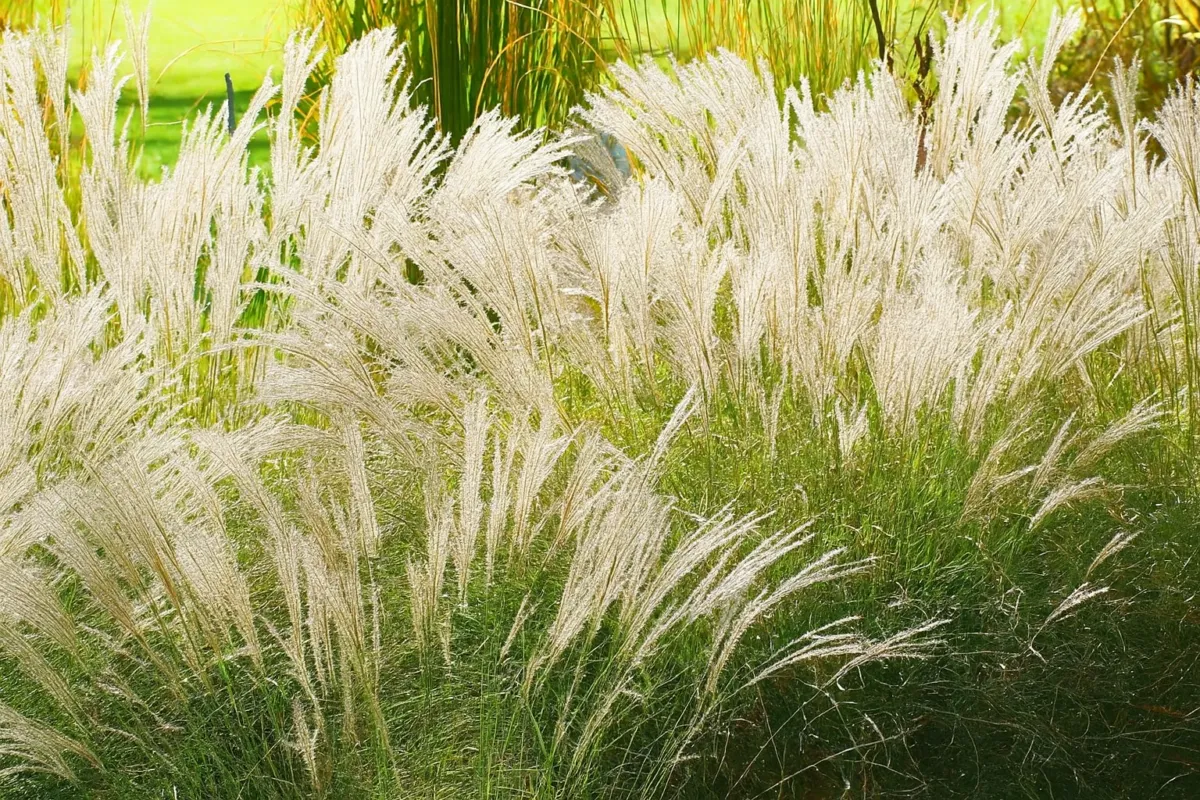
Also known as Eulalia grass. Thin, fine blades in a thick upright clump. Blades grow very tall – gorgeous seed heads rise just slightly above. Depending on the cultivar, seed heads start beige or reddish, fading to silver. Be conscious when selecting a cultivar – heights can vary greatly. The most popular varieties are typically the silver-variegated 'Morning Light,' the white broad-bladed 'Variegatus,' and the all-green 'Gracillimus.' Try 'Purpurascens' for flaming orange fall color.
Grass Species #4: Sesleria autumnalis
- Hardiness zone: 5-8
- Dimensions: No more than 1' in any direction
- Seed heads: Tight, light-colored bundles
- Fall/Winter Interest: Limited. Seed heads are best in fall
Also known as "Autumn Moor Grass." This petite grass behaves like a more formal Sporobolus. Stiff, fine leaves form a round, discrete clump. Tawny seed heads open to fluffy white in fall. This grass can tolerate nearly anything except humid and damp conditions, thus it tolerates the drying winds of a high-rise roofdeck more bravely than others. Though it's not much to look at in winter, the bright yellow-green of its blades is the perfect complement to purple and yellow blooms during the growing season.
Grass Species #5: Schizachyrium scoparium – various cultivars
- Hardiness zone: 3-9
- Dimensions: Typically 2.5' tall by 2' wide
- Seed heads: Irregular
- Fall/Winter Interest: Bronzy orange foliage in fall; typically stays upright in winter
Also known as "Little Bluestem." Medium in stature, this grass has lots of character. From a low, round mound of horizontal stems shoots a thick upright mass of stems, culminating in tiny, intermittently arranged tufts of seedheads. This grass can take quite an abusive summer and is hardy to -30 degrees. Most selections are aqua-colored or powder blue, and named as such. For bright red fall color, try 'Blue Heaven.' For something different, check out 'Carousel,' which looks gray-green from a distance but has bright tones of blue and red up close.
Grass Species #6: Panicum virgatum – various cultivars
- Hardiness zone: 5-9
- Dimensions: 5-6' tall by 2-3' wide at maturity
- Seed heads: Airy, upright panicles
- Fall/Winter Interest: Stays mainly upright in winter
Also known as "Switch Grass." This grass manages to be both elegant and beefy, a perfect grass for creating a soft, mid-height visual barrier. The majority of the stems are vertical and of even height; a good grass for spaces where a disciplined, minimalist look is desired. The cultivars offer great variety; 'Shenandoah' has burgundy-red tips and 'Heavy Metal,' is a uniform steely blue. 'Northwind' is the most commonly seen cultivar. Dried in winter, the tall stalks are reminiscent of corn or wheat bundles in a field.
Remember that to increase their chances of survival on a roof deck, even the toughest grass will appreciate regular watering during its first warm season and a layer of mulch during its first winter. A layer of insulation within the container or planting bed will also protect roots; this is doubly important if your containers are shallow, thin, or in an extra-exposed location. Aesthetically, it's hard to make a mistake with these plants… don't be afraid to plant multiple kinds in the same landscape, or a solid matrix of one kind. In any design, naturalistic or formal, ornamental grasses are ready to go to work for you!